Cessna TTx Model T240
Piston • single engine • Low Wing • Fixed gear
Range Visualization
Origin: · click map to move · nm at current load
Payload vs. Range
Customize assumptions
Default: 190 lbs (FAA standard)
Default: 30 lbs
Mission Profile
- High-Performance
About the Cessna TTx Model T240
Overview
The Cessna TTx is a composite, fixed-gear, low-wing four-seat single produced from 2013 to 2018, and the final evolution of a design that began as the Lancair Columbia 300 in the late 1990s. The lineage runs Lancair Columbia 300 and 400, acquired by Cessna in 2007, rebranded as the Cessna 350 and 400 Corvalis, then refined into the TTx. Buyers searching under any of those names are looking at variants of the same fundamental airframe: a clean composite structure, a fixed undercarriage, a low-drag profile, and a turbonormalized Continental TSIO-550-C delivering 310 hp. The TTx is the most polished iteration, adding the Garmin G2000 touchscreen avionics suite and several refinements to the cabin and systems.
At 235 KTAS at FL250, the TTx is the fastest fixed-gear piston single ever certificated. It outpaces the Cirrus SR22T on cruise speed and matches it on service ceiling, while carrying more usable fuel (102 gallons versus the SR22T’s 92) and yielding meaningfully longer practical range. The tradeoffs are four seats versus the SR22’s five, the absence of a whole-airframe parachute system, and a thinner used market. Total production across the TTx era reached 261 units before Cessna closed the line in February 2018, citing low demand against the Cirrus’s dominant market share.
Key Features for GA Buyers
- Speed. 235 KTAS at FL250 on 17 to 18 GPH is the TTx’s headline number and it is genuine. The aircraft competes with light twins on block time for long cross-country trips. No other certificated fixed-gear piston single approaches it.
- Garmin G2000 avionics. Two 14.1-inch landscape displays, GTC 570 touchscreen controller, GFC 700 autopilot with envelope protection, synthetic vision, ADS-B In and Out, and TAWS-B are all standard. The factory integration is several generations ahead of the panel typically found in earlier Columbia and Corvalis examples.
- Composite airframe. The carbon-fibre composite structure is aerodynamically clean and corrosion-resistant. Combined with the fixed gear’s simplicity, it yields an airframe rated for 25,200 flight hours, well above metal-airframe norms.
- Fixed gear. No hydraulic system, no gear doors, no actuators. The fixed undercarriage eliminates a significant category of mechanical failure and simplifies the annual inspection. The aerodynamic penalty is offset by the composite airframe’s low overall drag.
- Range. 102 gallons usable yields approximately 1,107 nm with NBAA IFR reserves at standard 65 percent cruise, or 1,250 nm at maximum-range power settings. The TTx is a serious long-distance platform for a four-seat aircraft.
- Utility category certification. The TTx is certified in the Utility category with a 4.4 G positive limit load and a 158-KIAS maneuvering speed, both unusually high for the class. The result is a more compliant turbulence platform than competing Normal-category designs.
- FIKI-approved. The TTx is certified for flight into known icing, with TKS weeping-wing protection on the wings, tail, propeller, and windscreen.
Trade-offs
- Four seats, not five. The SR22T seats five; the TTx seats four. For buyers who regularly carry four adults, this is not a constraint. For anyone who occasionally needs a fifth seat, it closes the door entirely.
- Thin used market. Production ended in 2018 after a relatively short run (261 TTx-era units). Late-model examples are scarce and command prices of $500,000 to $700,000 or more. Liquidity at resale is limited compared to the SR22 fleet.
- Composite maintenance specialization. Annual inspections benefit from a shop with composite airframe experience. Not all facilities have it, and those that do often carry a premium. Budget slightly more than a comparable metal-airframe aircraft for annuals and any structural repair work.
- Turbocharged engine management. The TSIO-550-C requires careful CHT and TIT management, as with any turbocharged Continental. Shock cooling on descent is the primary discipline required, and published TBO is 2,000 hours.
- No CAPS. The Cirrus SR22T carries a whole-airframe parachute system. The TTx does not. For buyers to whom CAPS is a meaningful safety consideration, this is a genuine differentiator in favour of the Cirrus.
- Unpressurized at FL250. Despite the 25,000-ft service ceiling, the TTx is unpressurized. Supplemental oxygen is required above 12,500 ft MSL for extended operations, and a built-in or portable oxygen system is essential to access the speeds the airframe is designed for.
- Useful load with full fuel. Top off the 102 gallons usable and 413 lb remain for crew, passengers, and baggage. Maximum useful load is 1,070 lb, so payload-versus-fuel tradeoffs apply on shorter legs with four occupants aboard.
See Also
- Cirrus SR-22 Turbo – Direct competitor; five seats, CAPS whole-airframe parachute, slightly slower cruise, larger and more liquid used market. Compare
- Lancair LC-41 Columbia 400 – Direct predecessor; same airframe and turbocharged engine, older Avidyne or Garmin G1000 avionics, lower purchase price. Compare
- Lancair LC-40 Columbia 300 – Normally aspirated sibling in the same composite lineage; lower operating costs and reduced altitude performance. Compare
- Cirrus SR-22 – Normally aspirated counterpart of the closest competitor; five seats and CAPS at a meaningfully lower price point. Compare
- Piper M350 – Pressurized step-up; adds cabin pressurization and a sixth seat at the cost of retractable-gear complexity and higher operating costs. Compare
Technical Specifications
Dimensions
- Wingspan
- 36.1 ft
- Length
- 25.2 ft
- Height
- 9.0 ft
- Parking area (ft2)
- 1392.22 ft2
Weights
- Max Takeoff Weight
- 3,600 lbs
- Max Landing Weight
- 3,420 lbs
- Useful Load
- 1,070 lbs
- Fuel Capacity
- 102 gal
Performance
- Cruise Speed
- 235 KTAS
- Never-Exceed (Vne)
- 230 KIAS
- Max Structural Cruise (Vno)
- 181 KIAS
- Approach Speed
- 78 KIAS
- Stall, Clean (Vs1)
- 60 KIAS
- Range
- 1107 NM
- Service Ceiling
- 25,000 ft
- Rate of Climb
- 1400 fpm
- Takeoff over 50 ft obstacle
- 1,900 ft
- Landing ground roll
- 1,260 ft
Similar to the Cessna TTx Model T240

Lancair LC-41 Columbia 400
Cirrus SR-22 Turbo
Cirrus SR 22
Lancair LC-40 Columbia 300
See how the Cessna TTx Model T240 stacks up against similar aircraft
External Media
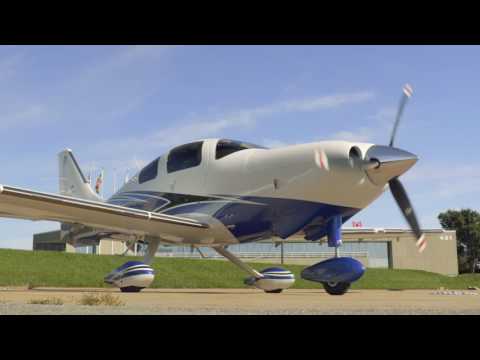
Image Galleries
_(4-13-2024).jpg?utm_source=choosemyplane.com&utm_content=textlink)

Other Links
-
Cessna TTx - Wikipedia en.wikipedia.org
-
Cessna TTx - Plane & Pilot (pilot report and SR22 comparison) planeandpilotmag.com
-
The TTx's Demise - AVweb (why it was discontinued and what it means for owners) www.avweb.com
-
AOPA Pilot Report: Cessna TTx - Prime Performer www.aopa.org
-
-
Flying Magazine: We Fly Cessna TTx www.flyingmag.com